
I've already had, in another part of the site, the opportunity to talk about my lack of visual imagination, which has hindered me both in math (complete absence of mental representations) and in guitar (enormous difficulties even after 40 years of practice and hundreds of concerts in “seeing” the shapes and paths of scales, modes, etc. on the fretboard) and life in general (complete inability to imagine something I haven't already seen, to have precise mental images from reading, etc.).
An apple is an apple, right?
A recent conversation with my daughter showed me how far this goes and how difficult it can be to understand for those who don't have this problem, not to mention those who, on the contrary, have a strong visual imagination. So my daughter sent me an Instagram video by someone called @drsermedmezher. In this video, the speaker asks us to close our eyes and imagine a red apple. So, okay, I close my eyes and focus on the idea of a red apple. Basically, after 5 to 10 seconds of sincere effort, I was able to see this:

And yet the shape isn't as round as it appears in the image. In fact, I don't even know if it's something my brain has produced or simply a variation in light on my eyelid. So, a vaguely round shape, black/charcoal gray on a background of the same color with blurred contours that swarm around, and, contrary to what the image might suggest, no sense of volume—it's completely flat. In short, this is how I manage to mentally create the image of a red apple, a fruit that I have encountered and observed hundreds of times in my life. The guy then asks us to compare what we saw with a series of drawings:
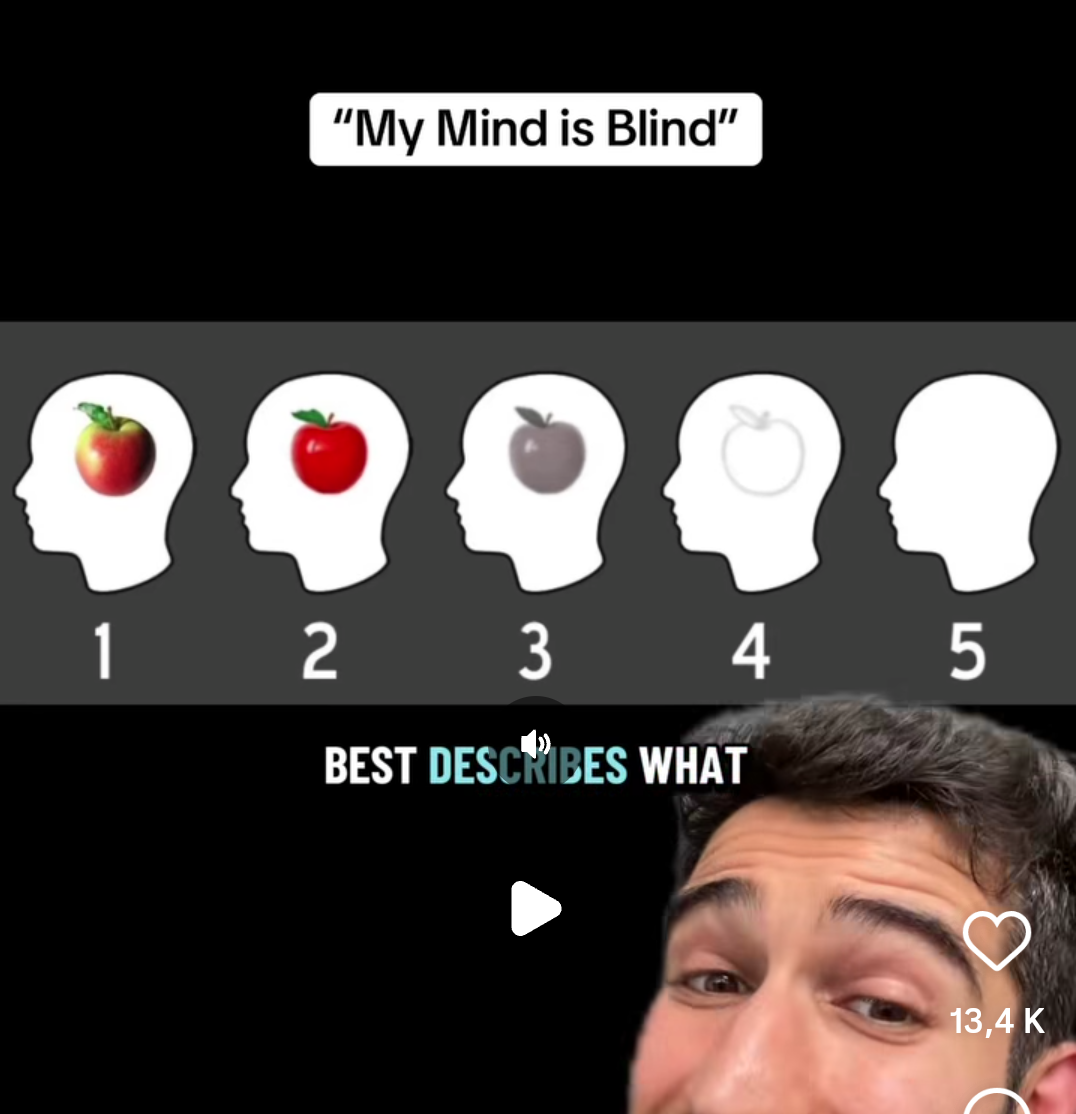
I'm not even listed!!! Or somewhere around 4.95. So I ask my daughter:
— And you? Where would you be?
— Oh well, I'd say 0.5 because not only can I see it perfectly in every detail, but I can also hold it in my hand or place it on a piece of furniture...
— WTF? This is science fiction!
Behind the mirror
Since the video also mentions mental monologues, let's start there: once again, she “talks to herself in images” most of the time, whereas I talk to myself 50% in words and 50% in “nonverbal communication.” I know it's hard to explain, but that's how it is... I also learn along the way that some people never talk to themselves... We then move on to the representation we have of numbers and words; she asks me if I associate colors with them.
— Uh, no... Numbers, I've got a line going up and down. From 0 to 10 it goes down, then it goes up to 20 and then goes down to 70. It goes up dry to 80 and down to 90 and goes up very dry to 100. And I have the same line for the hundreds up to the thousands, for the thousands up to 100,000. After 100,000? I'm not going too often. 😉 The sounds? I have sensations but no colors, words? Ben I have a line for the alphabet too, but not any color for the words even those who designate them. Anyway, I don't even see the words.
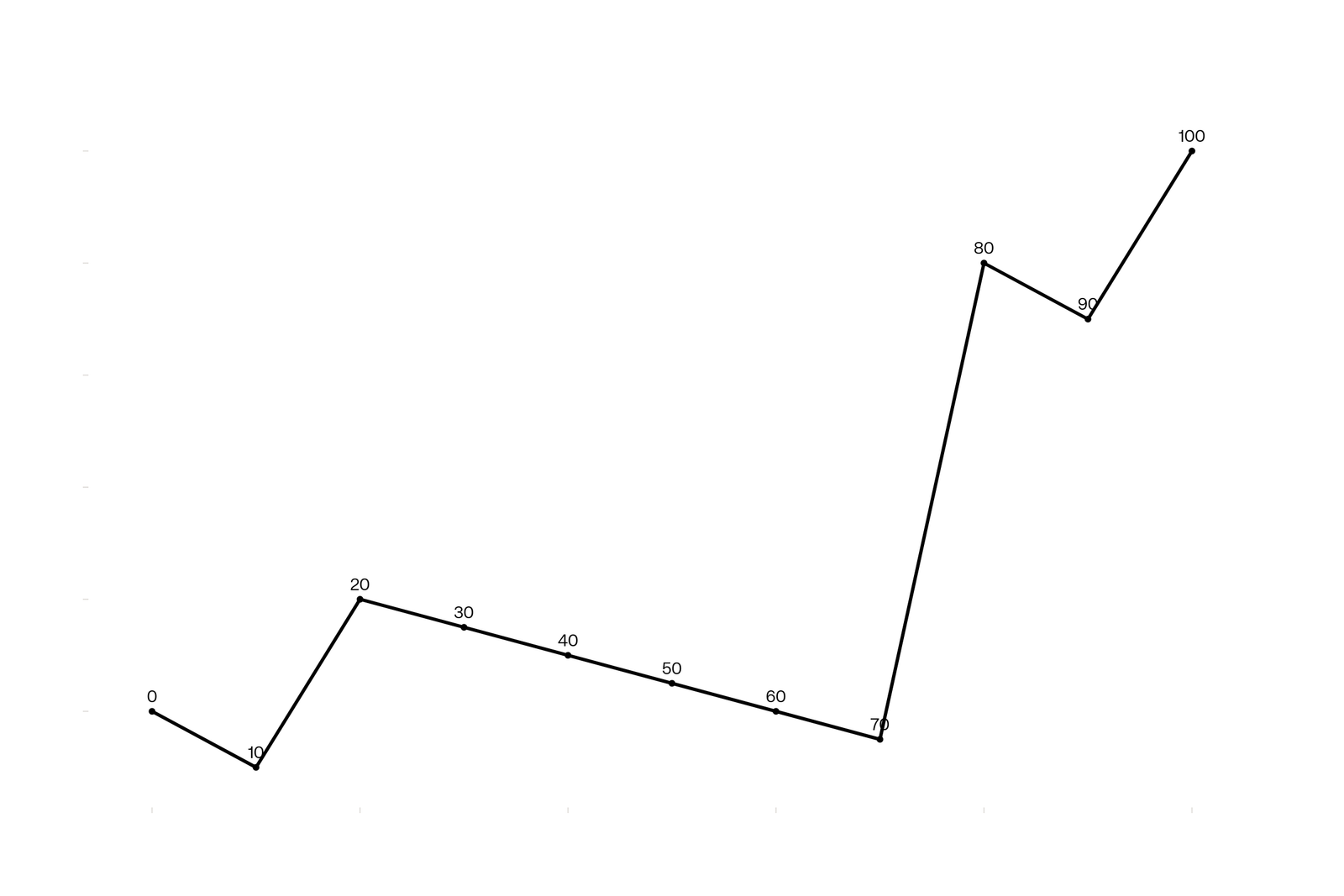
Now it's her turn to hallucinate, my lines are light years away from what she visualizes for numbers: she sees them with colors and clouds of color, like dust clouds... And again, on my side, no colors: black, white, gray at best. I see the line in sections, I can visualize it from 3/4 in front, 3/4 behind, but that's it. When I was a child learning my multiplication tables, I would mentally position myself close to the result. The same was true when doing mental arithmetic. I still do it today, it's automatic and very fast. But without this mental representation of the sequence of numbers, I don't know if I could calculate in my head, something I do very well. I also have a line for dates, months, years, centuries of course; for the alphabet too. I hear words, I only think them, but I don't see them. My daughter sees them and even recognizes the font in which they appear (but that's a professional bias).
Curious, I gave my partner the apple test, forgetting to tell her that the apple was red (obviously, since for me the main challenge was the apple, not the color), so she saw it as green but with detail level 2. She also associates colors with numbers and words. Strangely enough, this little test and the discussions that followed calmed me down, even though it further increased my awareness of the poverty of my visual imagination. Our mental representations and inner dialogues are so different, so unique to each of us, that it is logical and inevitable that they favor certain inclinations or aptitudes over others.
Doubting
I later learned that this lack of mental imagery is already known, that it has been named aphantasia, and that it affects between 1 and 3% of the world's population. Furthermore, it is a spectrum rather than something uniform from one individual to another, and it can also affect other senses (we will discuss this further in future posts). All of this opens up a vast and dizzying field of reflexion that deserves its own section on this site.
On this fertile ground of questions and revelations, other questions arose, which I will discuss in future posts.
Beside
When it comes to math, that definitely puts an end to “you gotta work, you gotta learn your theorems, you gotta do your homework,” etc. When you have my level of mental visualization, you can already forget about geometry, Cartesian planes, vector calculus, function representation, equations, etc. That leaves... well... not much, actually. So, for that reason alone, I don't have too many regrets about math after all.
For the guitar, this explains why, despite periods (days, weeks) during which I focused on digesting the CAGED system and the “road map” of the fretboard, I was never able to rely on a clear and immediate visualization of the paths on the fretboard. It's only half absorbed and erodes very quickly. For this reason, I rely solely on a combination of muscle memory in my fingers and immediate thinking. It works pretty well, but thinking while you play means wasting time and lacking anticipation. I would give anything to see the notes lined up as clearly as on a piano, to visualize in the moment what I can/want to play. I've heard guitarists talk about visualizing the fretboard and seeing the notes unfold in their heads just before they play them. After 40 years of playing guitar, I know that won't happen to me, simply because I don't have that ability, no matter how much time and energy I devote to it.

