
So there you have it, everything could have ended there, in a climax, I could have put it all in my pocket and put a handkerchief on it, after all I was off the hook. But nooooooooooooo my boy, it's not that simple! I hadn't just spent my time screwing up maths, no.I'd also started playing several instruments: flute, keyboards, a bit of bass and three or four years later, I was going to start guitar seriously. And, all the while, no matter how motivated I was and how hard I studied music theory, I felt I wasn't quite getting the hang of it, I was missing a key (no, I'm not going to make this joke ;-)), I was missing something...
Then, a few years after the baccalaureate, I remembered a sentence from my philosophy teacher who, incidentally, had mastered the art of the flute. An innocuous sentence in the context of an unrelated thought: “Music is the highest expression of mathematics...”. I didn't really pay attention at the time, especially as he added “...and above that, there's only God!”, which convinced me that he'd had a minor meltdown. Well, he hadn't! He was right (about the music, anyway. For God? I don't know and I don't want to).
Indeed, while I managed honorably with the basics of solfeggio, as soon as we got down to the nitty-gritty stuff - things that involved juggling the mathematical relationships between notes, inversions, transpositions, modes, composed bars, rhythmic decompositions - MBS and I would spend a fortnight vaguely grasping a notion that a math geek understood, integrated and mastered perfectly in half a second. I might as well say that it took me forever to understand certain things, and to this day I'm more than passable when it comes to music theory. I've got the basics, not the subtleties.
And here I take pleasure again: you math teachers! Why did I have to wait for a philosophy teacher in my last year of high school to point out the intimate relationship between math and music? Why haven't any of you been able to tell us, let alone show us? And then you complain that maths isn't appreciated by half the students? So once again, yes, I have my share of responsibility, I could have been more inquisitive, but you've sabotaged the whole thing from the start, with your lunar and almost sectarian presentation of the discipline you teach. With MBS, well established since my twelfth year, even on the rare occasions when I tried to fight against it, I didn't have a single hope. None at all! Why couldn't any of my maths teachers talk to the music teacher and work up a little session demonstrating (they liked to demonstrate, if I remember correctly) the relationship between math and music? We all loved music in those days, damn it! This would have been so easy...
I can see you coming: “Still, you've learned about note duration, you've seen that bars are divided into beats...”. Yes, but I didn't see what that had to do with maths. For me, it was music, period. Arithmetic in a pinch, but certainly not math. And I don't think anyone (before my senior year philosophy teacher) pointed it out to me so that I could bridge the gap in my head. Remember that I don't visualize much and, moreover, to all those born after 1985, please also understand that we grew up without smartphones, tablets, computers, the Internet or YT tutorials.
So if your family wasn't mathematically literate, if they didn't have the financial means to pay for private lessons, if your neighbor wasn't an engineer or even a maths student, when you didn't understand, you had very little chance of getting it right.
In retrospect, I realize that choosing guitar over keyboards wasn't necessarily the best choice I should logically have made, even though I love the guitar knowing that my mental representations range from rudimentary to non-existent. What's more, my teacher at the time, Mauro Serri, was one of those who popularized the CAGED System (see below).
On a keyboard, the notes are clearly lined up in front of you, so you don't struggle to distinguish them from each other once you know their names. The keyboard's geography jumps out at you thanks to the layout of the black and white keys, and the repeated pattern all over it. On guitar, it's a whole different story: your mind has to recognize the notes on the six strings and integrate the shapes and paths of the different chords, scales, modes, arpeggios and so on.
What's more, the intervals between the open strings change between G and B, we have a major third when everywhere else we have a right fourth, which introduces a shift of one fret. It's as if, on a keyboard, you had one less white key, and all the following keys went down a semitone. To make matters worse, on the guitar, certain notes, even notes at the same pitch, can be played in different places, something that doesn't exist on a keyboard.
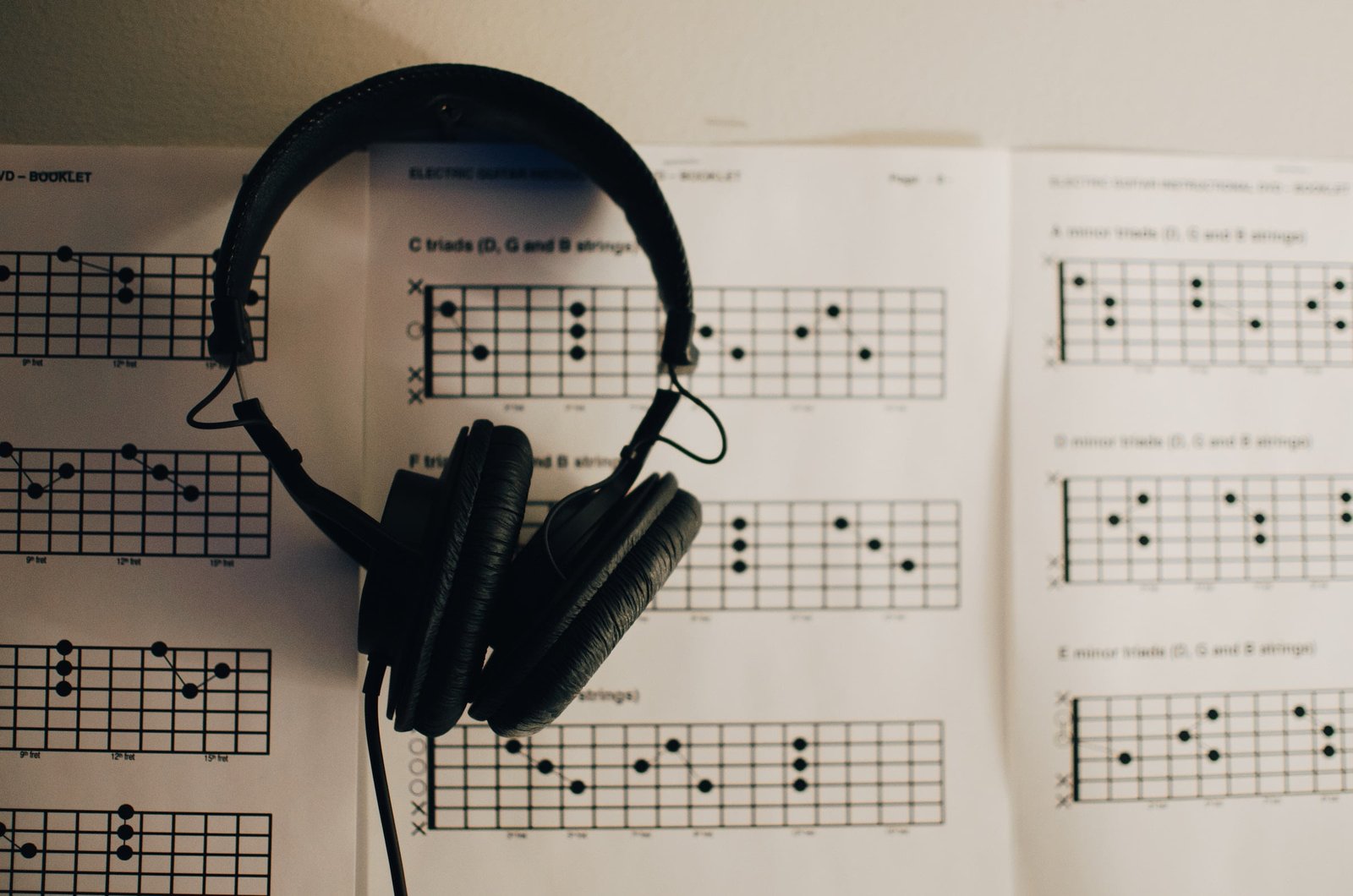
The CAGED system is an interesting way of constructing this fretboard map, based on the chord shapes we learn as beginners: Do, La, Sol, Mi, Ré (C,A,G,E,D according to Anglo-Saxon notation). You also gain in ease on the fretboard when you visualize how the different shapes of a single chord always follow each other in the same order. I quickly understood this in theory, but in practice it took me 10 years to transpose this intellectual understanding to the fretboard, to visualize (more or less) notes and paths, and to allow my fingers to absorb this knowledge so that I no longer had to think about it (too much). There again, I know that with a better level of maths and a maths/music connection highlighted and made explicit at a younger age, I would have progressed much faster, despite my lack of “visual intelligence”.
But the litany of collateral damages does not stop there...

