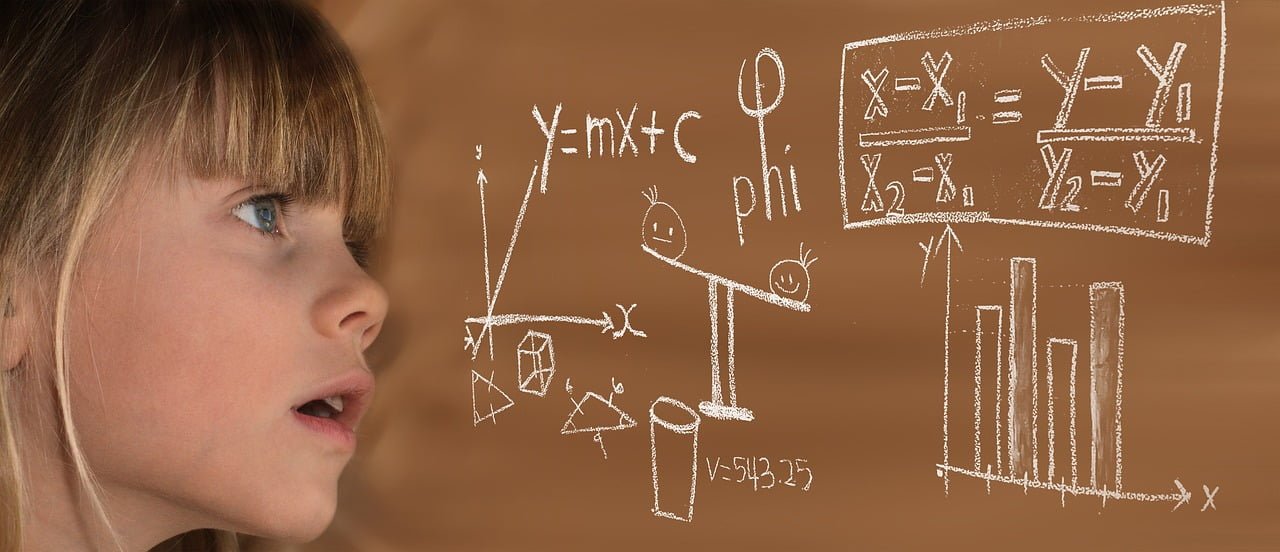
You don't tell them that you are a victim of “MB (Melting Brain) Syndrom”: over time, your brain has developed a defensive mechanism against this unmanageable mass of informations and what was at first just a gentle daydreaming, “à la Cancre de Prévert”, becomes a systematic behavior, a well-established habit, a survival reflex. Basically, as soon as the brain sees, hears or suspects a formula, an axiom (I still don't know what it is but I wanted to use the word), a line of logic or a mathematical equation, everything that enters your gray matter is transformed into a vast incomprehensible gobbledygook.
You read your statement and the lines start to dance, the sentences no longer make any sense. MBS works like a scrambler, a protection, an anti-maths armor. It protects you in spite of yourself. You have to start again ten times before you can distinguish a word which, in isolation, is of no use to you anyway. So you start again from the beginning and... it gets worse: you fail right from the first line. The more you try, the less cooperative your brain will be.
To such an extent that you end up wondering what you're doing to yourself and, above all, why you're doing this to yourself.
If someone tries to explain it to you, whether it's the professor or one of your friends, you find yourself in the shoes of those movie characters who have just been in an explosion or are feeling unwell: everything you hear is fuzzy, the high frequencies are missing. You see a mouth and a tongue moving and you hear a fog of reverberating sounds without being able to synchronize the two. You look up and there you meet the eyes of your interlocutor who, conscientiously, continues his work of explanation, with a penetrating air, conscious of his mission. He starts to have doubts, either because of your lack of reaction or because he has noticed your dead fish stare. If it's the teacher, you retreat even deeper into your inner self, because, well, he's going to have to let you get away with it! He has other students to look after, doesn't he? If it's a mate, you let him know that it's OK as it is, either by playing the “whoever understood, let's not talk about it” game or, if he's a real friend, by acknowledging that you haven't understood anything yet but that there's no point in going over it again.

That, in a nutshell, is the “Melting Brain Syndrom” and, like any reflex, it's instantaneous, totally involuntary and beyond any control. If you want to get a vague idea of the process, go and read the Wikipedia page on linear equations (I bet some of them are quite convoluted, maybe...).
Extract:
Algorithmic or geometrical techniques from linear algebra or analysis are used to solve them. (already at least two obscure concepts). Changing the variable definition field can significantly change the nature of the equation (okayyyyyy...).
Rebel, rebel!
What's more, and here's another key, I think, we spend a large part of our adolescence, a turbulent period if ever there was one, hearing things like: “I'm not going to demonstrate this to you because you wouldn't understand the demonstration. So I'm going to ask you to accept the formula and learn it by heart...” When you're thirteen or fourteen-years-old, that's exactly the kind of speech you should avoid because you hear things like: “You're too stupid to understand, so just learn and apply.” Sounds appealing, doesn't it? Or: “Maths becomes really interesting and fun in university.” All said with a hint of nostalgia in the teacher's eyes. By extension: “In high school, we only do boring stuff.” Well, if the teacher says so, maybe I won't bother learning all this crap when my hormones start to kick in... I've got better things to do, haven't I?
Anyway, and I saw it much later, thanks to the modern maths + Servokifon combination, I managed to go through 8 years of college/lycée (yes I "voluntarily" doubled my third because my mother, optimistic of nature, absolutely wanted me to pass in Second C (S today), which of course never happened. 😉 ); So, I said, I managed to spend all these years, without realizing that the letters in the equations represented numbers Hey! And no, I'm not that stupid, it's just that I was out there and the guys in there didn't even know that someone could ignore this obvious, even over-obvious, evidence that they weren't even mentionning it. Then, of course, later, part of the fault is mine, but curiosity for maths had been extinguished for too long.
As previously written, the presentation of math, at least at the time, had everything to isolate them in a strictly mathy world, of concepts and representations unrelated to the rest and especially to the real. So for me, letters were letters, and numbers were numbers. Now, after carefully avoiding saying "numbers" when they spoke of sets (rationals etc.), they did not specify that the letters they used represented numbers. So I didn't understand at all why these people, on the other hand relatively normal, tried to practice mathematical operations on letters. It was completely over my head.
Just imagine you being in front of this:
ax+b=cx-d
without knowing that each letter represents a number and that, if necessary, the thing must be solved. It's like being in front of a foreign language that would use signs you know but would be so far away from your own language that you wouldn't have any beginnings for understanding. If you have already visited Finland, you know what I mean.
At first, you ask a few questions, but since you don't know what they're talking about, your questions lead to answers that are, at best, dubious and, at worst, pointless. If you have to write, you'll try to answer them roughly (axb=cxd, abcd, acdc, cbd?), they're necessarily off the mark. It's a real mess, and if the teacher is well-intentioned, he'll try to fish out one or two fragments so as not to give you a grade of zero. However, since he doesn't understand your answers, he can't help you. From time to time, especially at the beginning of the year, he asks you to come to the blackboard. But the slightest thing you write makes everyone laugh (even the two or three students who are as bad as you). Logically, after a while, he gives up because he has a class to lead and a program to finish.
You understand that, too, and you're tired of fighting windmills. You're getting better at literature because you spend your math class reading Vian, Kafka, Van Vogt, and Asimov at the back of the room. The teacher leaves you alone and you don't disturb the class—it's a gentleman's agreement.